

Perforated panels are often presented as a spectacular decorative product — a massive facade pierced with a pattern visible from afar. That’s true, but only part of the reality. In our shop, perforated panels mostly leave for more everyday and more useful applications: condo guardrails, balcony privacy panels, ventilation grilles that step beyond the conventional, green-wall supports.
What makes the product interesting is exactly that versatility. The same fabrication process — perforated, folded, finished sheet — can solve very different problems depending on how it’s designed. Here’s how, concretely, this product comes to life in real projects.
Four applications where perforated panels excel
1. Condo guardrails and balustrades
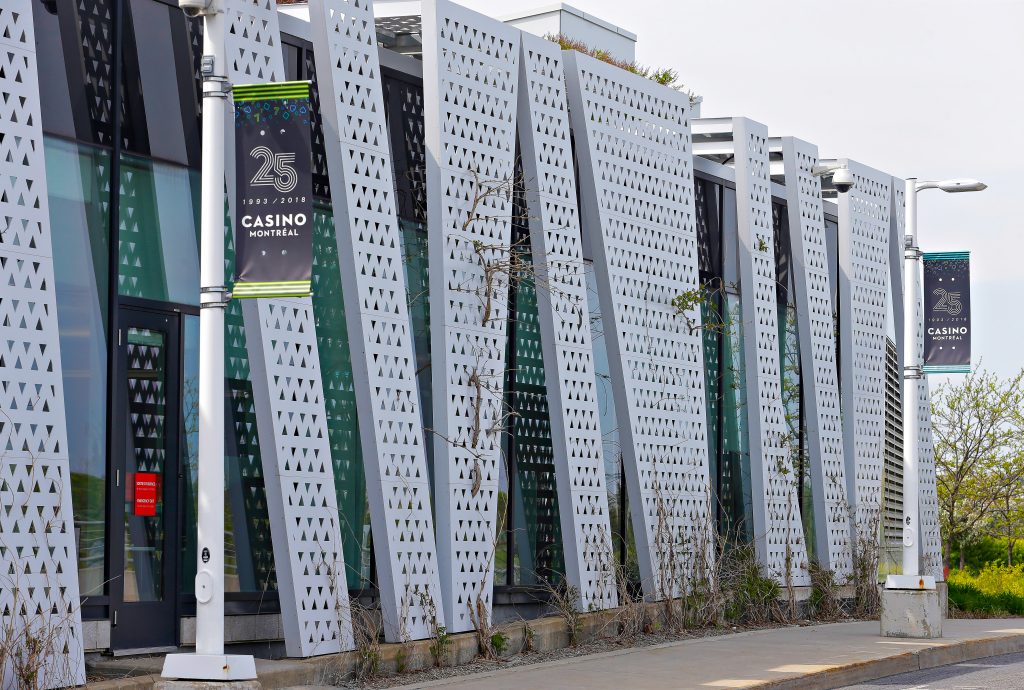
Probably our most frequent application. A perforated aluminum guardrail offers a hard-to-beat combination: it blocks wind enough for occupant comfort while letting in light and views, it does not corrode like steel, it is light for the supporting structure, and it accepts a wide range of finishes (paint, anodizing).
For condo developers, it’s also an architectural signature that distinguishes a project without costing as much as a full curtain wall.
2. Privacy panels on balconies and terraces
In dense residential projects, the separation between balconies has become a design challenge. Perforated panels offer the ideal compromise: they create a real visual barrier while avoiding the “opaque wall” effect that darkens the neighbour’s terrace and apartment. The open area is calibrated case by case based on the level of privacy required.
The same principle applies to rooftop mechanical screens: equipment is concealed without creating a blind volume that visually weighs down the building.
3. Ventilation grilles that aren’t boring
Architects increasingly refuse standardized industrial grilles that break the reading of a refined facade. Perforated panels allow ventilation grilles to be integrated directly into the building’s architectural vocabulary: same colour, same pattern, same module as the main cladding.
You can literally make an air intake or vent disappear by cladding it with a perforated panel that extends the facade. It’s the kind of detail that makes all the difference in a building’s perceived quality.
4. Green wall supports
A fast-growing application: perforated panels serve as the support structure for interior or exterior green walls. The perforated grid allows simultaneous attachment of planting modules, air circulation around the root system, and drainage. It’s a clean, durable solution adaptable to complex geometries.
When patterns become a building's identity
Beyond functional applications, perforated panels also enable strong visual signatures. A few concrete examples of Cyrell AMP projects:
- Théâtre de Quat’Sous (Montréal) — a perforated facade that has become part of the neighbourhood’s visual identity
- Holt Renfrew Ogilvy (Montréal) — architectural cladding that marries luxury with metalworking craftsmanship
- New Louis-Hippolyte-La Fontaine bridge-tunnel ventilation building
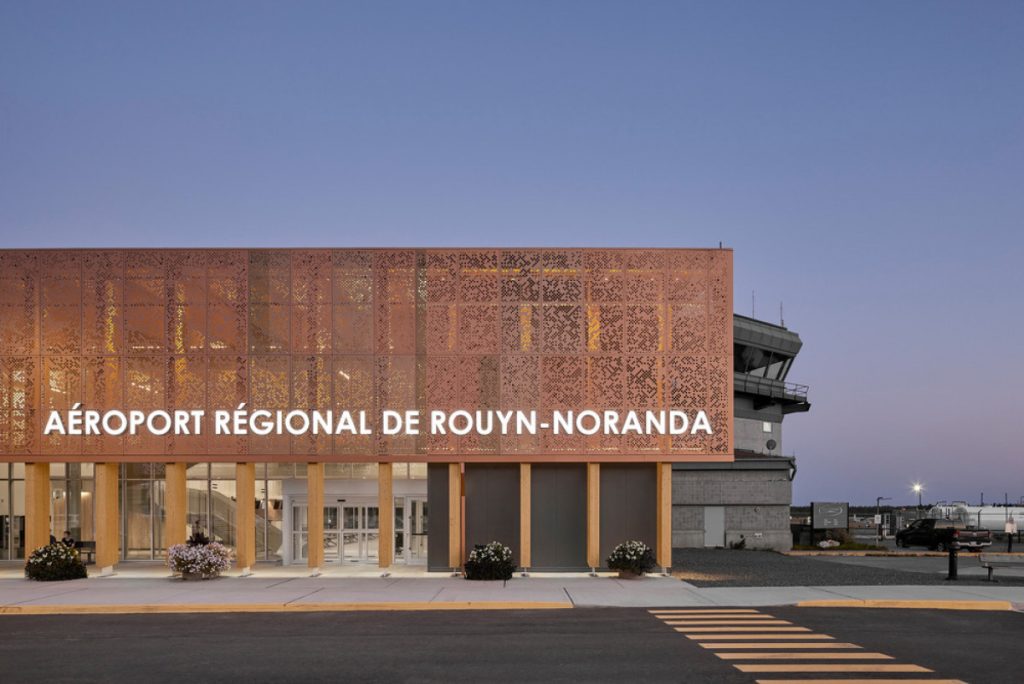
- Rouyn-Noranda airport
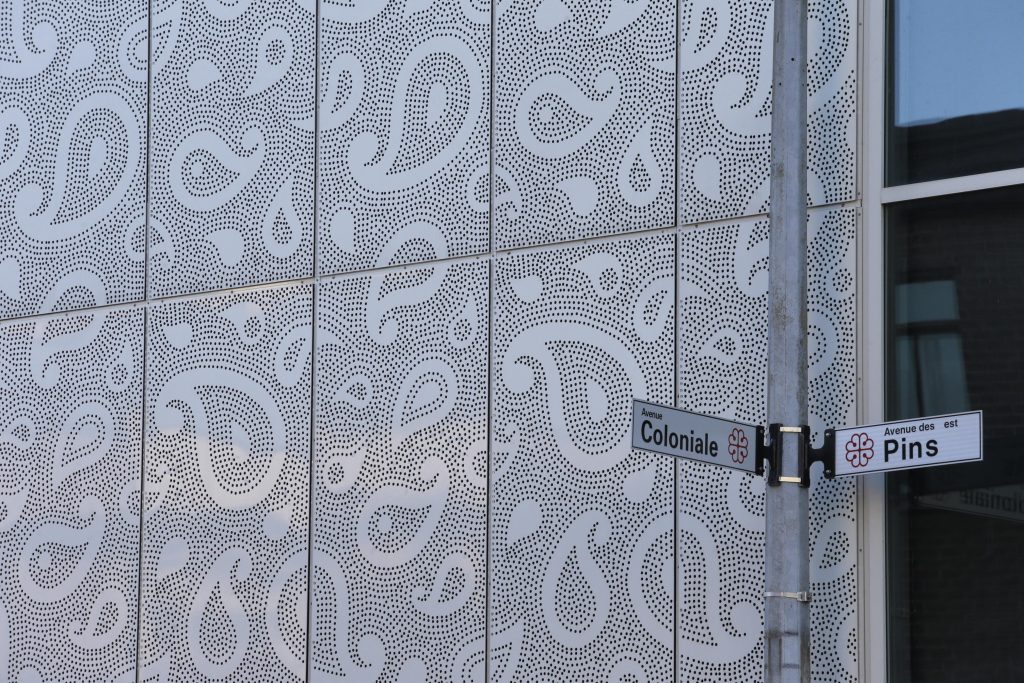
In this kind of project, the perforated pattern is no longer just a product: it becomes an architectural signature. A custom pattern can evoke an image, text or recognizable graphic, and with backlighting, the facade literally becomes an architectural screen.
The real fabrication rules to know
Golden rule: perforation cannot be smaller than the material thickness
This is THE rule every designer should know. If you want 3 mm holes, your sheet cannot be thicker than 3 mm. The closer you get to a 1:1 ratio (hole diameter = thickness), the more sensitive fabrication becomes: risk of burrs, tool breakage, irregularities. For harder materials like stainless steel, you need to give yourself even more margin.
Concretely, if an architect wants a fine pattern with very small perforations, you either accept a thinner sheet (less rigid) or revise the pattern. There’s no shortcut.
Hardness, warping and fabrication precautions
The harder and more rigid the material, the less it will tend to warp after perforation. Weathering steel (Corten) and stainless steel, naturally more rigid, hold their flatness better when significant material is removed. Conversely, aluminum — softer — can wave visibly if the open area is high without hidden stiffeners.
In return, aluminum remains easier and faster to perforate in the shop: less tool wear, higher cutting speeds, simpler finishing. The right choice depends on the aesthetic-budget-geometry trio: you don’t treat a condo guardrail the same as a monumental facade.
Thickness depends on the visual and the panel type
There is no “standard” thickness for an architectural perforated panel. Thickness is chosen based on several combined factors: the visual rendering sought (perforation depth, projected shadow), the type of panel into which the perforation integrates (cassette, clipped, custom), the span between fixings, the open area and the material hardness. It’s a dialogue between architect and manufacturer — not a catalogue choice.
The materials we perforate (and those we avoid)
Not all metals are equal for perforation. Here is our position based on experience:
✅ Aluminum
The most common choice in architecture. We mainly use alloys 3003, 5052 and 5005, depending on the requirements. 3003 offers excellent formability (ideal for tight folds), 5052 resists corrosion better in aggressive environments and offers higher rigidity, and 5005 is preferred for large flat panels with refined anodizing.
✅ Stainless steel
Excellent when durability and corrosion resistance are paramount, or for high-end projects with a brushed finish. Requires more precautions in fabrication (tooling, speeds), but holds its flatness very well.
✅ Weathering steel (Corten)
A strong aesthetic choice for projects connected to their natural environment: pavilions, interpretive centres, park facilities. The characteristic brown patina of Corten is compatible with perforation, contrary to popular belief.
❌ Prepainted or galvanized steel — no, and here’s why
It’s a firm rule at our shop: we do not perforate prepainted or galvanized steel. The reason is simple: every hole creates a sharp unprotected edge. On prepainted steel, the edge exposes the substrate to corrosion; on galvanized, the cut breaks the protective zinc layer. In both cases, the coating’s protection is compromised at hundreds (or thousands) of points per panel. The medium-term result: creeping corrosion, blisters under the paint, compromised aesthetics.
If a project absolutely requires a “prepainted perforated steel” look, the right approach is to perforate raw steel, then apply the finish after perforation so the coating also covers the edges. We explain this on every request that comes in this direction.
Why fabrication matters
The final quality of a perforated panel depends as much on the manufacturer as on the design. A large-format panel demands:
- Perfectly regular cutting across the entire surface (fibre laser or high-precision punching)
- Mastered bending that does not deform the pattern at junctions
- A finish (paint, anodizing) applied flawlessly despite thousands of perforations
- Suitable packaging and handling, as perforated edges are fragile
At Cyrell AMP, our perforated panels are produced on high-precision fibre laser and punching equipment, at our 64,000 sq. ft. facility in Beloeil, Québec. Whether for a condo guardrail, a privacy panel, an integrated ventilation grille or a monumental facade, we support architects from pattern design through to on-site delivery, across Canada and the Northeastern United States.

Conclusion
Perforated panels are not a single product: they are a family of solutions answering very different needs, from the most utilitarian (guardrails, privacy, ventilation) to the most expressive (facade signatures). Properly designed from the start, fabricated with the right materials and according to the real technical rules — perforation ≥ thickness, no perforated prepainted steel, finish after perforation — they turn an ordinary building into a refined piece of architecture.
Exploring the integration of perforated panels into an ongoing project? Our team can support you from the conceptual stage to optimize the pattern, material and fabrication.